oligo-anuria
Medicina
Verbete 1 de 1
substantivo
Contexto: "Seventy-seven children (47 males) were retrospectively studied, median age of 4 months. Mean length of hospital stay was 7.33 ± 0.16 days, 68.9% of patients received mechanical ventilation, 25.9% had oligo-anuria, and peritoneal dialysis was performed in 42.8%."
Fonte: RIYUZO, Marcia C. et al . Predictive factors of mortality in pediatric patients with acute renal injury associated with sepsis,. J. Pediatr. (Rio J.), Porto Alegre , v. 93, n. 1, p. 28-34, Feb. 2017 . Available from <http://www.scielo.br/scielo.php?script=sci_arttext&pid=S0021-75572017000100028&lng=en&nrm=iso>. access on 04 June 2019.
Fonte: RIYUZO, Marcia C. et al . Predictive factors of mortality in pediatric patients with acute renal injury associated with sepsis,. J. Pediatr. (Rio J.), Porto Alegre , v. 93, n. 1, p. 28-34, Feb. 2017 . Available from <http://www.scielo.br/scielo.php?script=sci_arttext&pid=S0021-75572017000100028&lng=en&nrm=iso>. access on 04 June 2019.
Termo equivalente: oligúria ou anúria
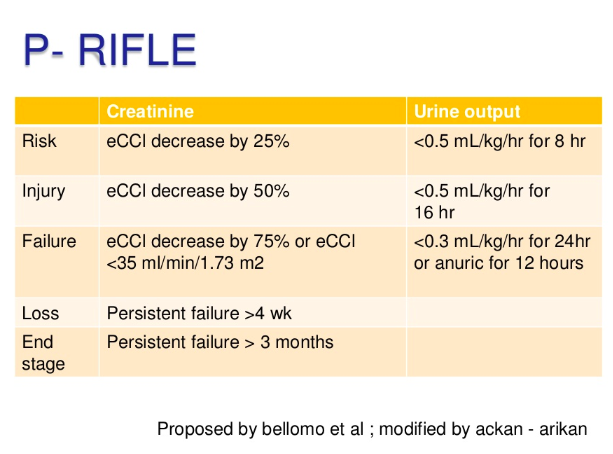
Definição: "Polyuria is defined as urine output of more than 4 ml/kg and h and oliguria as less than 0.5–1.0 ml/kg and h. Anuria is the absence of urine for 12h. All of them are markers for pRIFLE criteria. The incidence of acute renal failure in a neonatal intensive care unit ranges from 1.5% to 23%. [...]. If oligo-anuria (a term that involves oliguria or anuria) is recognized, many urgent questions arise, and the potentially underlying conditions should be recognized."
Fonte: Al-Hermi, B., Al-Saran, K., Secker, D. et al. Pediatr Nephrol (1999) 13: 401. Available from <https://doi.org/10.1007/s004670050630> access on 04 June 2019.
Fonte: Al-Hermi, B., Al-Saran, K., Secker, D. et al. Pediatr Nephrol (1999) 13: 401. Available from <https://doi.org/10.1007/s004670050630> access on 04 June 2019.
Definição em português: "Poliúria é definida como a produção de urina de mais de 4 ml/kg/h, oligúria como menos de 0,5-1,0 ml/kg/h. Anúria é a ausência de urina por 12h. Todos eles, são indicadores para o critério pRIFLE. A incidência de insuficiência renal aguda em uma unidade de terapia intensiva neonatal varia de 1,5% a 23%. [...]. Se oligo-anúria (um termo que involve oligúria ou anúria) for reconhecida, muitas questões urgentes surgem, e as condições potencialmente subjacentes devem ser reconhecidas."